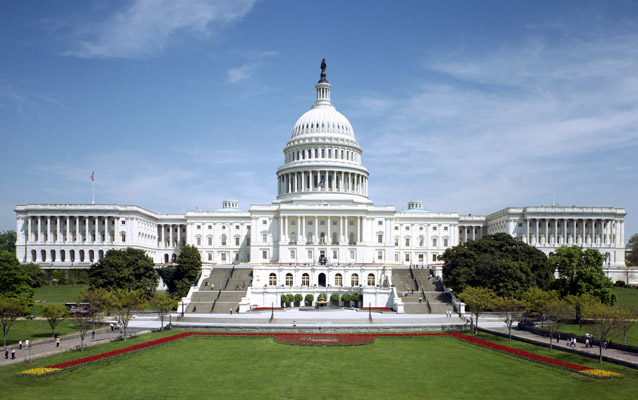
The attack on the Capitol last Wednesday showed us the dividing line that matters more than any other for our country.
The differences between conservatives and progressives, Republicans and Democrats, are real and important. Enduring racial disparities present profound challenges, as does the widening gap between our wealthiest and poorest citizens. Various regions of the country, economic sectors, and demographic groups have conflicting interests that drive them to compete for advantage.
All of those differences and distinctions are significant and complex, but none is beyond the ability of our system of laws and our democratic processes to address, albeit in an often-imperfect manner and at a pace that can be excruciatingly slow.
The demarcation that truly counts is the one that separates the great majority of Americans who are committed to working within that system of laws and through those democratic processes from those at either extreme of the political spectrum who are willing to use violence, destruction, and intimidation to pursue their ends.
The 9/11 terrorist attacks gave us a renewed – if fleeting – appreciation of the fact that what unites us as Americans is much greater than that which divides us. Will we be able to draw – and sustain – the same realization from an attack conducted not by Al Qaeda hijackers but by those from within our own midst who would hijack the electoral process?
If so, we need to begin with an unequivocal, universal rejection of the use of violence as a tool of domestic politics. That sounds so obvious as to not merit mention. But for such a stand to be meaningful, it must go beyond a pro forma condemnation of a particular violent episode or group of people to be truly unequivocal and universally applicable.
That means no rationalizations that give a scintilla of legitimacy to those who threaten or actually engage in violence. After the mob stormed the Capitol last week, many conservatives roundly denounced the lawlessness without caveat or qualification. A few, however, followed their disavowals with words about the importance of recognizing the pent-up frustration that had led to the assault. When some of the racial justice protests this summer provided an excuse for a small subset of participants and hangers-on to engage in arson, looting, and attacks on people, there were some among the much larger ranks of peaceful activists who termed that violence the regrettable but inevitable consequence of people being denied justice and opportunity. What an insult, in both instances, to the overwhelming majority of people who feel frustrated with the political process, or who long have struggled with the burdens of injustice, but who have opted for engagement and activism within the bounds of the law.
It also means no “whatabout-ism” – the temptation to follow criticism of people on one’s own side of the political divide with protestations that similarly unacceptable behavior by those in the opposing camp hasn’t received comparable media attention or public censure. “Yes, what a few extremists who don’t represent the mainstream of our movement did was absolutely wrong, but a few months back when the other side did essentially the same thing, where was the outrage then?” Anyone in a marriage or other committed relationship knows that responding to a reproof by dredging up an instance where your significant other did much the same leads to rounds of recrimination, not rapid reconciliation.
This is not to suggest that all acts of violence are morally equivalent. People who loot a business are committing an inexcusable act that should be fully prosecuted, but that just doesn’t compare with breaking through windows in the Capitol to try to prevent our elected officials from carrying out a Constitutional duty that is part of the electoral process. However, one of the many benefits of condemning all acts of political or politically related violence is that we don’t have to spend time calibrating our criticism or engaging in fruitless debates about what constitutes the greater wrong.
Our country is in greater need of unity than at any time I can remember. Paradoxically, the first step in that direction requires an act of separation – of casting out of the body politic those who would administer violent remedies for its ills. Conservatives need to take the lead in showing right-wing extremists the door, while progressives have a parallel obligation to close the door on leftist zealots. By putting distance between themselves and those of like mind who would employ intimidation and cause injury, conservatives and progressives reduce the distance between one another.
The horrifying scene at the Capitol provides vivid proof that each American has to choose a side – not between right and left, but between embracing the view that the ends justify the means or deciding that the rule of law and the democratic process must prevail, even when they don’t yield the results we may have wanted.
 Better Americans